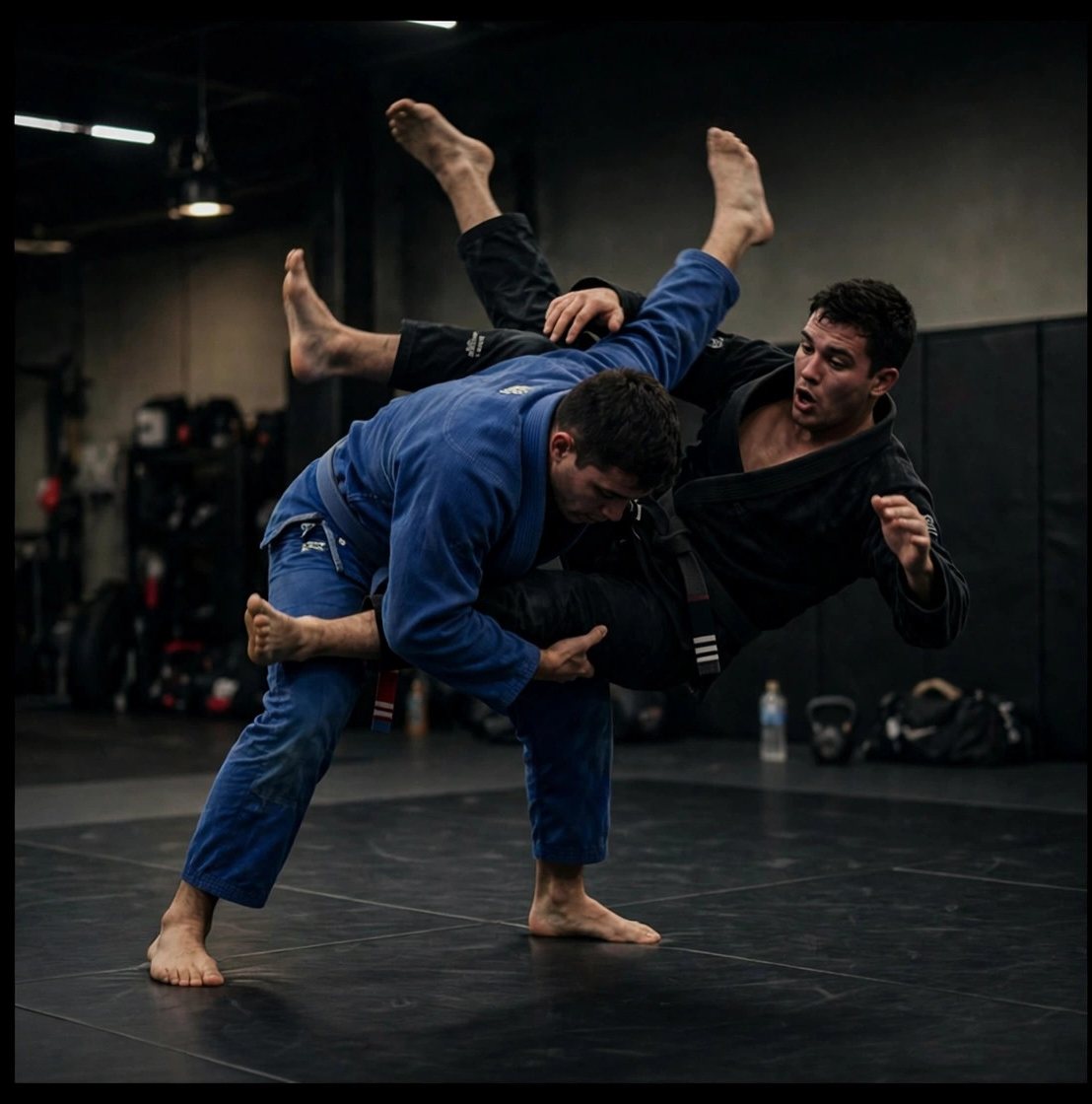
Coach Pat breaks down the ankle pick: control up top, catch the ankle as their weight steps forward, and finish on top. No explosive shot needed — a low-risk takedown built for beginners.
Watch the reel
Shots, trips, and throws that start you on top.
Coach Pat breaks down the ankle pick: control up top, catch the ankle as their weight steps forward, and finish on top. No explosive shot needed — a low-risk takedown built for beginners.
Watch the reelJunqueira posts this as a quiz: name that throw. From the clinch he loads his partner across his shoulders and dumps him to the mat — his commenters land on kata guruma, the fireman's carry, one calling it a reverse entry. A judo classic that scores in BJJ.
Watch the reelGhoneim asks "have you seen this takedown before?" — it's kani basami: jump across the lead leg and scissor both legs out from standing. Know it to recognize it, not to throw it: banned in judo and under IBJJF rules for the knee injuries it causes.
Watch the reelA full chain in one reel from Nikolas Koretsis (Brasileiros champion, 3-0 on Polaris): arm drag from standing, straight onto the back, rear naked choke to finish. Three shelves of this matrix in one sequence — the drag is the entry, the choke is the destination.
Watch the reelDominic Mejia, an ADCC world semifinalist, answers three takedowns with one idea — don't fight the fall, roll through it. Double leg, uchi mata, single leg: each gets rolled out so the defender lands on top. Requires real rolling and breakfall skill.
Watch the reelBrian Glick teaches the knee pick as a door, not a destination: if your partner doesn't react, run through and pick up the leg for the takedown — if they retract the leg, the opening left behind fits your turn throw, morote or seoi. Feints chain the low attack to the high one and double your chances.
Watch the reelJudo coach Uktamov Yakhya teaches the major outer reap from farther out than it's usually played: close the distance, break their balance backward, and reap the leg out from behind so they fall away from you. One of judo's foundational throws — and in the standup game, a way to put someone down without ever shooting in under them.
Watch the reelBrian Glick chains two throws from this card: show o-soto gari with a backstep entry to hide your real intention, take the cross-grip to frame the elbow, then step down hard and bring your hip to the outside to finish the seoi nage. His own caveat rides along — turn throws expose your back in jiu-jitsu, but some are too good to pass up.
Watch the reelNazar Nazarenko adapts judo's major hip throw to no-gi. With no lapel to pull, the entries and grips change; the engine doesn't — turn in tight, load him onto your hip, and rotate him over it to the mat.
Watch the reelCole Johnson calls it a cheat code. The lat drop needs no shot and no level change: from a standing tie, as your partner steps in, fall with your weight and take him over with you — landing on top. Timing and commitment do what strength does in other throws.
Watch the reelA Korean judo hall chains the two outer reaps: drive in for o-soto-gari, and when your partner steps out or shifts their weight to survive it, take the leg they just saved with ko-soto-gari, the small outer reap. Big threat, small finish — the same read-and-react logic as Glick's chains, in pure judo form.
Watch the reelBoston Submission Fighting builds this footsweep out of a reaction instead of chasing the foot: collar tie and wrist control, step behind the lead leg to trap it, lean your partner forward until they step back to save themselves — then sweep the trailing leg in the moment its weight leaves it. The sweep is the easy part; manufacturing the step is the technique.
Watch the reelHarrison Everett introduces judo's corner reversal the memorable way — by flipping an actual sheep with it, then showing the real version on the mats: pull guard, insert the butterfly hook, control the head, and roll backward to flip your partner over the top. A sacrifice throw that plays like a sweep: you give up your feet to take theirs.
Watch the reelToronto wrestling coach Neal breaks down the fireman's carry step by step: shoot in, load your partner across your shoulders, and dump him over the top. It's the wrestling twin of the kata guruma already on this card — same throw, two sporting dialects — and his version comes with a coach's full breakdown instead of a quiz.
Watch the reelLegion AJJ teaches the motion underneath the foot sweep rather than the sweep itself: clinched up, backstep and run your lead leg away — one, two — then pivot and rotate back in with your foot landing on his shin, and he goes down. The caption's promise is the lesson: drill the cut-away and your foot sweeps start landing, because the sweep was never the hard part — arriving at the angle is.
Watch the reelCanadian national judo champion Maxim Côté adapts the follow foot sweep to no-gi: track your partner's steps, count two to set the rhythm, then sweep both feet as they come together mid-stride. It completes this card's footsweep family — Boston's manufactured the step, Legion's found the angle, this one rides the rhythm.
Watch the reelDominic Mejia's answer to the standing rear body lock: step into a runner's stance, trip him with your back leg, take the tricep, post a hand on the floor and spin through — you land on top. His second entry on this card, with the same signature as his first: defense that doesn't just escape, it reverses.
Watch the reelMarwan Wardak posts it as a quiz, and his comment section answers with a name: this is Hassan Yazdani's signature takedown — from the underhook, drive your partner backward and tap the far knee out from under him as he steps. No shot, no level change: pressure makes the leg available, and one hand collects it.
Watch the reelMarrom Jaguar — an IBJJF South American champion — starts forehead-to-forehead in the tie-up, drops his level, takes the leg and drives straight through to put his partner on his back, settling into control. A commenter asks for the name and gets no answer; the mechanics name it themselves: a single leg finished by the drive rather than the lift.
Watch the reelJaime Esteban, an MMA coach, ports judo's big outer reap into the cage: same reap and upper-body drive, re-gripped for a world with punches — no lapels, and the entry has to survive strikes. It is this card's fourth o-soto entry, and the set now spans the throw's whole range: long-distance gi, chained, feinted, and bare-handed.
Watch the reelBrian Glick's third entry on this card is a sacrifice throw with an engineer's spec sheet: sell it first with a kouchi threat until their posture breaks forward, plant the inside foot on the far hip for purchase, and switch the collar grip to the sleeve so they can't post or cartwheel out — then fall and launch. Three details, each solving the failure the previous one creates.
Watch the reelJJ Howland teaches a two-move chain with the doctrine in the title: the first attack is a trap — it draws the defense — and the second one, in his words, finishes 'em. His cue through the sequence is "down and across": sell the entry, drop the level, drive through the reaction you created. The same chaining logic Glick's entries run on this card, in wrestling-room form.
Watch the reelThomas — a judo black belt with six national medals — asks "have you ever tried this move?", and his comment section supplies both the name and the fine print: ko-soto gari, the minor outer reap, and it only bites when you create the momentum first. Shown in training and in ADCC competition footage, it pairs with this card's Kookmin entry, where ko-soto was the second half of a chain — here it headlines on its own.
Watch the reelMarwan Wardak posts another quiz, and his comment section argues it out before landing on the full answer: the arm drag is the question — the standard reaction is to pull back and square up — and ko-uchi gari, the minor inner reap, is the answer waiting for that reaction. His second entry on this card; the first was a quiz his comments named too.
Watch the reelBoston Submission Fighting's second entry on this card is a combination with a read built in: from an underhook and collar tie, L-step to your angle, then take what his step offers — far leg steps, fit the inside trip; lead leg follows, back-step into o-soto gari. One entry, two finishes, and the opponent's foot chooses which.
Watch the reelA judo hip throw rebuilt for no-gi. Sode tsurikomi goshi normally runs on the sleeve — lift and pull with the sleeve hand, then turn the hip under — and Jacc Pottt, a Montreal BJJ brown belt and MMA coach, shows how the entry survives with no sleeve to hold: wrist and arm control do the sleeve's job, and the hip does the rest. It becomes this card's second hip throw, after Nazarenko's no-gi o-goshi.
Watch the reelPart three of Solomon Choran's series, and a lesson in chaining: you run the kata guruma — the fireman's carry sitting at #2 on this card — your opponent blocks it, and instead of forcing the throw you switch to o-uchi gari, the major inner reap, through the space the block opens. Choran, a three-time Canadian national judo medalist, teaches the pair the way judo intends: the first throw asks the question, the second one answers it.
Watch the reelA syllabus in one reel. Marvin Pio, founder of Judo Mirai Dojo, runs the 2nd-kyu judo set end to end: ko-soto gari, ko-uchi gari, koshi guruma, tsuri komi goshi, okuri ashi barai, tai otoshi, harai goshi and uchi mata. Several already live on this card as single-technique entries — this is the shelf they belong to, the throws taught as a family rather than as singles.
Watch the reelPierre-Olivier Leclerc — black belt under Firas Zahabi, three-time IBJJF Pan champion — posts a wrestling-flavoured takedown with its defence pre-written: "Inb4 some fat guy who wrestled in high school tells me this doesn't work. Well sometimes it does." The catch: the caption never names the move, so it is filed under his own verdict — takedowns at this level are situational, and the honest claim is not "always," it is "sometimes, set up right." Know the name? The title updates.
Watch the reelGrappler Station — a Minnesota academy building kids on judo and jiu-jitsu — teaches the part of the foot sweep most reels skip: the drilling. This card already holds the sweeps themselves (the "crazy" no-gi footsweep, Legion AJJ's cut-away footwork, Maxim Côté's two-step okuri ashi barai); this entry is how you build the timing they all run on, with drills simple enough to run every class.
Watch the reelRenato Subotić, the MMA coach who builds his teaching as one complete system, turns the cage from scenery into a tool. Shoot the high crotch, drive your opponent back into the fence so the wall kills their sprawl, elevate with the hips, hook the leg, then pull back to finish. Four steps and each one sets the next — the fence does the holding that a free-standing partner's balance would never allow.
Watch the reelTaylor Weber — a US national sambo champion and MMA fighter — chains two of this card's staples without a gi: de ashi barai, the advancing foot sweep, flows straight into o-soto gari, the big outer reap. The sweep makes them step and post; the reap takes the posted leg's whole side down. It joins the o-soto shelf (long-distance, feinted, and MMA versions all live here) as the combination entry — proof the throws are stronger sequenced than solo.
Watch the reelMahan Qa — an Ontario wrestling champion who offers $1,000 to anyone who can take him down — keeps it simple: an easy hip throw. Load them on the hip, turn, and let gravity do the invoicing. It pairs with Nazarenko's no-gi o-goshi at Takedowns #9: the same ancient mechanic in two vocabularies, judo's and wrestling's — the hip does not care what language you name it in.
Watch the reelCoach Neal's second entry on the card — the Toronto coach who has trained 30+ national placers — sets the ankle pick off the 2-on-1: control one arm with both hands, drag their weight onto the far foot, and pick the near ankle while it is light. It pairs with Coach Pat's ankle pick at Takedowns #1 — the same destination by a different road, the tie buying the off-balance before the hand ever drops to the leg.
Watch the reelTaylor Weber returns to the shelf with a foot-sweep combination set: four ways the sweeps chain into each other, because the first sweep's real job is often to move the feet for the second. It extends his first entry here — De Ashi into O-Soto — from one combination into a small system, and it deepens this shelf's foot-sweep corner alongside Legion's cut-away footwork and Côté's two-step okuri ashi barai.
Watch the reelFiled descriptively: the caption names no technique, so the entry goes by its teacher — Patricia Sales, a specialist in women's self-defense whose work is about getting out of risky situations. The reel is a takedown from that world: practical and scenario-first, taught for the street rather than the scoreboard. If the throw gets a name, the title will follow it.
Watch the reelRandy William's rule is that he never posts what he does not do himself — and by his account he has been using this collar drag variation constantly, with a whole simple system built off it. The drag's real job is the reaction it forces: pull the posture across, and the popular Russian-style trip opens up on the far side. A takedown filed by its purpose, not just its first grip.
Watch the reelBoston Submission Fighting adds the no-gi throw this shelf needed: a takedown built entirely off the overhook — no collar, no sleeve, just the whizzer clamped down and the hips doing the throwing. On a page full of gi drags and trips, it is the reminder that the overhook is a takedown grip all by itself, for the days when there is no gi to hold.
Watch the reelThis one carries the name you gave it: the dump. Melanson — a BJJ Fanatics instructor whose whole brand is making jiu-jitsu easy — captions the reel only as a pointer to his full instructional, so the entry stays with what the name promises: a takedown whose point is putting the partner down decisively, not politely. If a fuller name ever surfaces, the title can sharpen.
Watch the reelFiled descriptively under the caption's joke: Sheppard — an MMA coach under Firas Zahabi — credits his man with 300 years of wrestling knowledge, give or take a few centuries. The caption names no specific takedown, so the entry keeps the gag as its title and the catch on the record; what is certain is the reverence underneath it — old wrestling knowledge, still putting people on the mat.
Watch the reelNottingham, taught this by Rafael Domingos in Vegas, draws the line between two heel-height judo throws that get confused: kawazu gake, the leg-entangling reap, and kibisu gaeshi, the heel-pick trip. They look like cousins at ankle height and are not — grips, leg action and risk all differ. Filed on your Takedown shelf; its bloodline is the new Judo section's. ⚠ Kawazu gake is prohibited in judo competition for the knee danger in the entanglement — know it, drill it carefully, don't expect to score with it under judo rules.
Watch the reelA judo corner reversal, tutored visually — the channel bills itself "Visual Judo: Learn by Watching," and the lesson is sumi gaeshi, the sacrifice throw that trades your standing base for a hook and a backward roll, lifting the partner over the corner. The Korean caption invites everyone who wants to get good at it. Judo bloodline, filed on your Takedown shelf: the archive's second sumi gaeshi, after Harrison Everett's sheep-flipping version.
Watch the reelA champion asks the room the question as the title, then answers by demonstration. Côté is a pro MMA fighter and Canadian national judo champion, with black belts in both judo and BJJ — but the record never names the throw he shows, so the entry files under his question and his credentials, and takes the throw's name if it ever surfaces.
Watch the reelA chain drilled as one motion: Maike, a coach at ETP BJJ who posts new drills weekly, runs the ankle pick straight into the guard pass — win the takedown, then pass before the guard can set. Filed on the Takedowns shelf at your label, where the chain starts; the pass is the second half of the same rep.
Watch the reelA Korean judo heel technique taught as a beginner drill: the Hwagyeong Judo Gym (Hwasun, South Korea) posts its practice method for an-dwi-chuk — hooking and sweeping behind the heel — marked "(for beginners)" in its own caption. The archive's judo keeps arriving in pieces: a Korean gym's foot sweep filed beside the champions and commanders.
Watch the reelEvery video is the creator's own, hosted on their channel — Grappling Matrix links out and credits them. Train within your limits and tap early.